

 English
 中文简体
中文简体

Industry News
Home / News / Industry News / Hot Steel Forging for the Wind Industry: Gearbox Components Explained in Depth
 Home / News / Industry News / Hot Steel Forging for the Wind Industry: Gearbox Components Explained in Depth
Industry News
Hot Steel Forging for the Wind Industry: Gearbox Components Explained in Depth
2026-09-11
A 10 MW offshore wind turbine gearbox transmits enough torque to move a freight locomotive, yet it has to fit inside the nacelle of a wind turbine a hundred meters above the ground. The planet carriers, planet gears, sun gears, and ring gears inside that gearbox are produced by hot steel forging. If one of these forgings carries an internal defect, the result is not a simple part replacement. It means a crane vessel, a drivetrain removal, and weeks of lost energy production. That is why hot steel forging for the wind industry is treated as a safety-critical step rather than a routine metal shaping job.
Content
Why Hot Forging for Wind Components
Hot forging is the preferred method for wind gearbox transmission parts because it produces a continuous grain flow and closes internal voids that casting cannot reliably eliminate.
When steel solidifies in a mold, it develops shrinkage cavities, gas porosity, and local segregation. Hot forging compresses the billet at temperatures between 1150 and 1250 Celsius, breaking up those imperfections and refining the grain structure. The result is higher density, better fatigue strength, and more consistent mechanical properties across the component. Wind turbine drivetrains experience a complete stress cycle with every rotor revolution, so fatigue resistance determines the service life more than static strength does. Tests on 42CrMo4 steel show that forged material can deliver a fatigue limit roughly 30 to 40 percent higher than the same grade in cast form. That margin often separates a 20-year drivetrain from a premature mid-life failure.
The radar chart above compares hot forging and casting across six criteria that matter for wind drivetrain parts. Forged steel shows a clear advantage in fatigue resistance and grain structure because the deformation process aligns the metallic flow with the load path. Internal soundness is also better in forgings, since the compression step welds shut the shrinkage porosity that remains in cast sections. Casting scores higher in cost efficiency and lead time, which is why large gearbox housings and non-loaded covers are still produced as castings. The components that carry torque and bending loads, however, are always specified as forgings. If you rank these criteria by their impact on turbine availability, the forged route wins for transmission parts.
The Forged Components Inside a Wind Gearbox
Most wind gearboxes use a planetary design to multiply the rotor speed from roughly 10 rpm to the 1000 rpm required by the generator. The forged parts are concentrated in the planetary stages, where torque is highest.
Planet Carrier
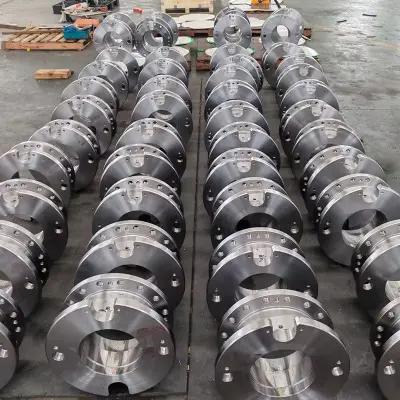
The planet carrier is the structural core of each planetary stage. It holds three to six planet gear shafts in precise radial positions while transmitting full turbine torque. In a 5 to 10 MW gearbox, a forged planet carrier blank typically weighs between 1200 and 2800 kg. The forging process must create uniform grain flow around the pin bores, because those areas carry the highest cyclic stress. A one-piece forged carrier avoids the weld seams that would otherwise become fatigue initiation sites.
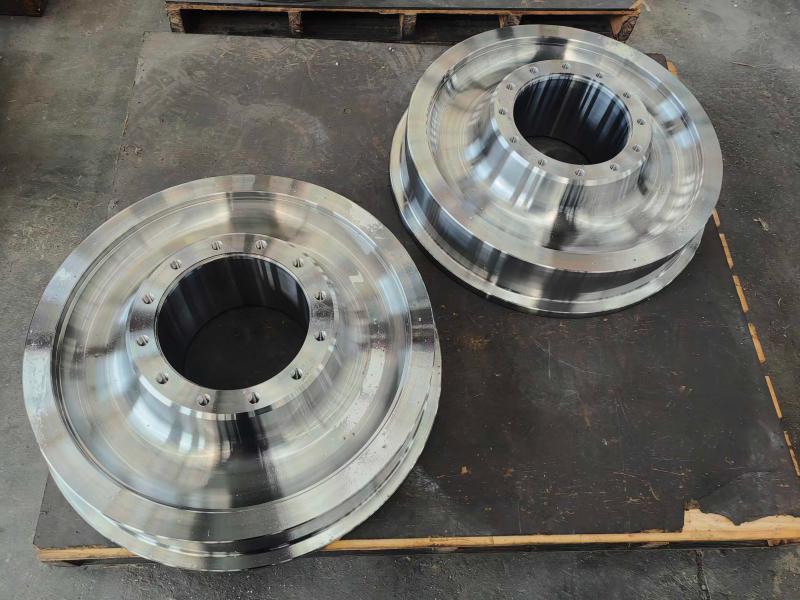
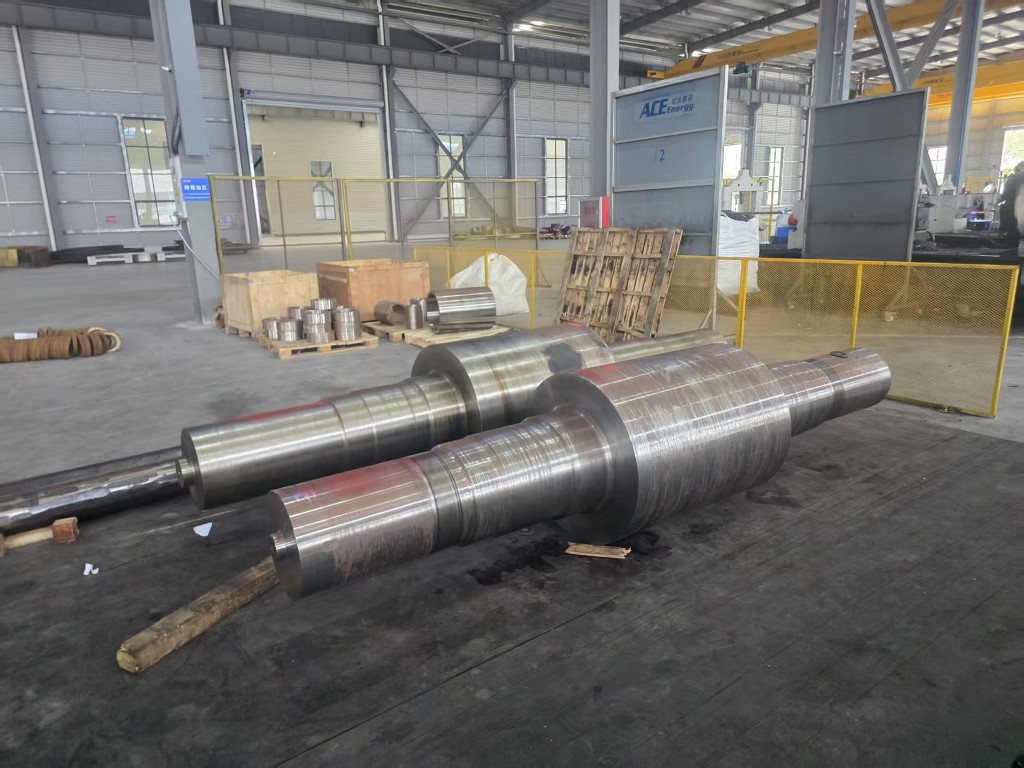 Forged Planet Carrier for 3-10 MW Wind Turbine GearboxesThis one-piece forged carrier suits 5-10 MW gearbox stages, with uniform grain flow around pin bores to handle high cyclic stress. Explore it for reliable large-capacity turbine drivetrains.View Product →
Planet Gear and Sun Gear
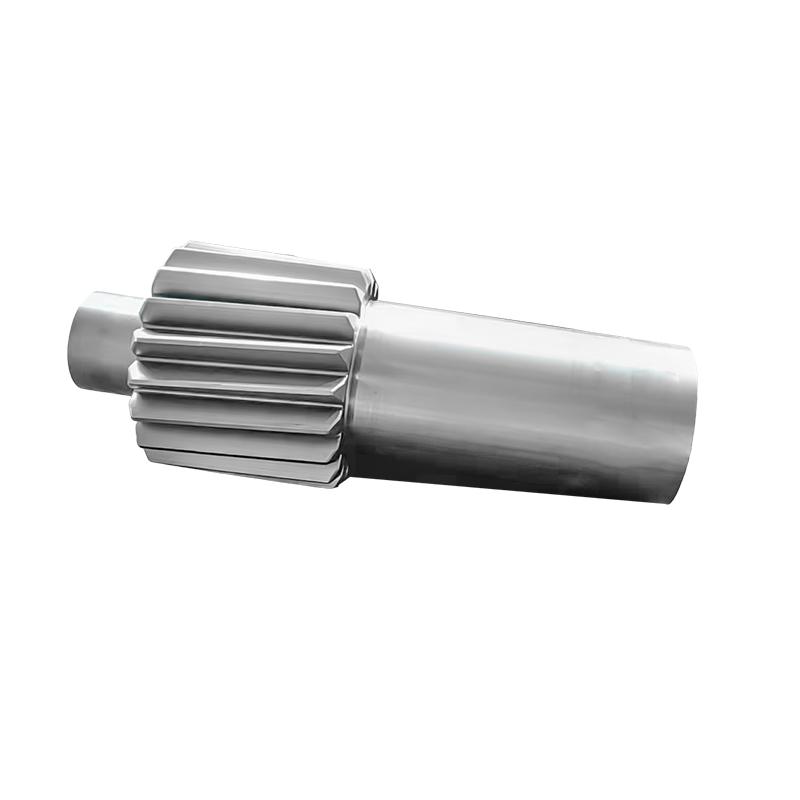
Planet gears mesh with the sun gear and the ring gear at the same time, which splits the transmitted load across multiple tooth contacts. In a 5 to 10 MW turbine, the first-stage planet gear carries the highest torque at the lowest speed. Sun gears rotate faster and require case-hardened steel to resist tooth flank wear. Both components are normally forged from 18CrNiMo7-6 or an equivalent carburizing grade. The forged blank is rough machined, gear cut, case hardened, and ground to the final profile.
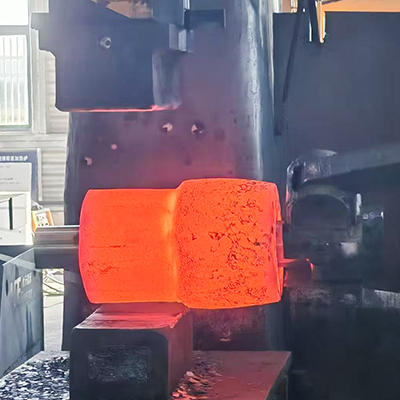 Case-Hardened Planet Gear Forgings for 5-10 MW GearboxesFirst-stage planet gears carry the highest torque at low speed, so forged 18CrNiMo7-6 blanks with carburized surfaces are essential. This product covers all three planetary stages.View Product →
Ring Gear
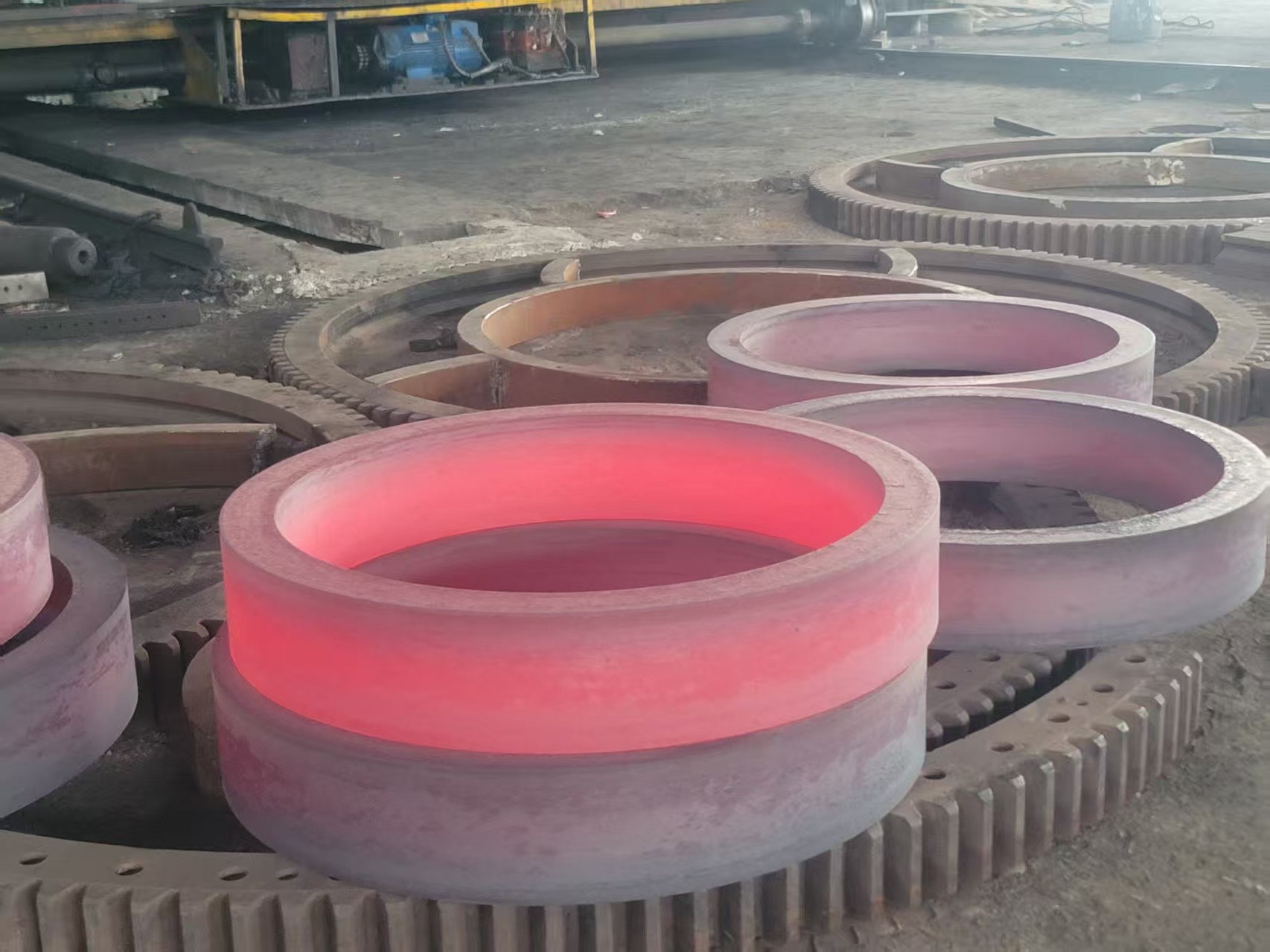
The ring gear is a large-diameter annulus with internal teeth. It can be produced as a one-piece ring forging or as a segmented welded assembly, but one-piece forgings distribute load better because no weld seam crosses the stress zone. Ring rolling on a vertical ring mill creates a grain orientation that follows the tooth root direction, improving bending fatigue resistance. A 5 to 10 MW gearbox ring gear blank can weigh from 1800 to 3500 kg, depending on the gearbox architecture.
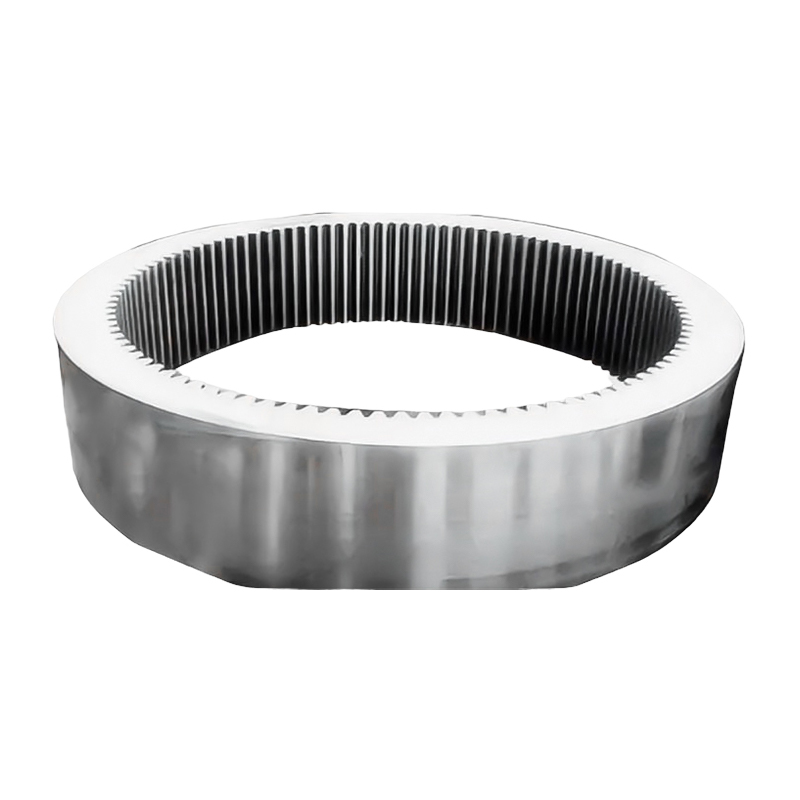 One-Piece Ring Gear Forgings for 5-10 MW Wind TurbinesLarge-diameter ring gear blanks up to 3500 kg benefit from ring rolling grain orientation and no weld seams. This product supports high-power transmission with precision-ground internal teeth.View Product →
The horizontal bar chart above shows typical forged blank weights for the main rotating components in a 5 to 10 MW wind gearbox. Ring gears are the heaviest blanks in the set, often exceeding 3500 kg before heat treatment and rough machining. Planet carriers are the second heaviest group because they are large-diameter discs with multiple pin bores. Gear shafts sit in the middle range, while planet and sun gears are lighter but still demand high-alloy steel and careful forging reduction. These weights determine the required hammer or press capacity, heating furnace size, and machining envelope. A supplier with 15-ton hammer capacity and a 1.5-meter ring rolling mill can cover the full range without splitting orders across multiple vendors.
The Hot Forging Process from Billet to Blank
Converting a steel billet into a certified wind gearbox forging follows a controlled sequence that combines deformation, thermal treatment, and inspection.
- Billet inspection. Ultrasonic testing is performed on the incoming billet to confirm internal soundness before any work begins.
- Heating. The billet is slowly preheated and then soaked at 1150 to 1250 Celsius in a gas-fired furnace.
- Upsetting. Axial compression breaks up the cast structure and refines the grain.
- Pre-forming. Drawing out and blocking create an intermediate geometry close to the final blank.
- Final forging. Closed-die or open-die shaping establishes the outer contour and critical thicknesses.
- Ring rolling. For ring gears and other annular parts, a vertical ring rolling mill expands the preform to the required diameter and cross-section.
- Controlled cooling. Slow and uniform cooling prevents flaking and residual stress build-up.
- Rough machining and re-inspection. The blank is rough turned to remove scale and surface defects, followed by another ultrasonic pass.
The line chart above shows how the rated capacity of offshore wind turbines has climbed from 4 MW in 2016 toward 12 MW in 2026. Every step up in turbine rating forces the gearbox to transmit more torque through the same physical envelope. Larger torque means larger planet carriers, bigger ring gears, and heavier forged blanks. The forging supplier must therefore invest in larger hammers, bigger ring mills, and deeper heat treatment furnaces to follow this trend. Buyers who plan a 12 MW platform should validate that their forging partner can handle blanks above 4000 kg. This capacity check is more important than price when the drivetrain design depends on it.
Material Selection for Wind-Grade Forgings
The steel grades used in wind gearbox forgings belong to two families: quenched and tempered alloy steels for carriers and shafts, and case-hardening steels for gear teeth that need a hard, wear-resistant surface.
| Steel grade | Min yield strength | Tensile strength | Typical components |
|---|---|---|---|
| 42CrMo4 | 650 MPa | 900-1100 MPa | Planet carriers, gear shafts |
| 34CrNiMo6 | 750 MPa | 1000-1200 MPa | Ring gears, heavy shafts |
| 18CrNiMo7-6 | 850 MPa | 1180-1420 MPa | Planet gears, sun gears |
42CrMo4 is widely used for planet carriers and gear shafts because it combines good strength with stable through-hardening. Fatigue design of the carrier pocket areas is the limiting factor, so the forging reduction ratio must be high enough to refine the core structure. 34CrNiMo6 offers higher strength for heavy ring gears and large shafts. 18CrNiMo7-6 is specified for planet and sun gears that must resist contact fatigue after carburizing.
The column chart above compares the minimum yield strength of the three grades in forged and cast condition. The forged versions show a consistent advantage of roughly 230 to 300 MPa over cast material of the same chemistry. That difference matters in gearbox design because yield strength sets the limit for bending stress at the tooth root and at the carrier pin bores. Higher yield strength permits either a more compact gearset or a higher safety margin at the same size. Cast production would require heavier sections to achieve similar load capacity, which increases gearbox mass and complicates the nacelle structure. This is why the design review of a wind gearbox almost always specifies forged blanks for every part in the torque path.
Heat Treatment and the Path to Final Properties
Hot forging shapes the blank, but heat treatment determines the final mechanical properties. Wind gearbox forgings normally pass through normalizing, quench and tempering, and in some cases surface hardening of the tooth flanks. Each step must be controlled to keep hardness uniform across large cross-sections. A 300 mm thick ring gear section requires a quenching process that cools the core fast enough to reach the required martensitic structure without creating cracks. Furnace loading, quench medium, and tempering cycle all influence the final toughness and residual stress. A working knowledge of metal heat treatment basics helps procurement teams discuss these parameters with suppliers and verify that the planned cycle matches the grade and section size.
How to Evaluate a Hot Forging Supplier for Wind Applications
A capable hot forging partner for wind components must demonstrate more than the ability to strike a billet. The evaluation should cover the full process chain and the control systems around it.
- Forging capacity. Check the hammer or press tonnage, the ring rolling capability, and the maximum billet weight that can be heated and forged.
- In-house heat treatment. Quenching and tempering must be done in controlled furnaces with documented temperature curves.
- Non-destructive testing. Ultrasonic inspection after forging and after rough machining is mandatory for wind-grade blanks.
- Traceability. Every blank should be linked to its heat number, forging record, and heat treatment report.
- Experience with large wind blanks. Ask for references in the 3 to 10 MW gearbox segment.
The importance of in-house heat treatment is often underestimated until a delivery is delayed by outsourcing. Speak directly with the process engineers rather than only with the sales team. Ask for the actual heating curves and ultrasonic reports from previous wind forging orders. A supplier such as ACE Machinery covers the complete route from billet heating to finished blank, which shortens communication lines and keeps quality data in one place. Verification of these capabilities before placing an order is the most effective way to avoid quality problems later.
Hot steel forging for the wind industry remains a demanding but well-understood discipline. The components are large, the loads are cyclic, and the cost of failure is extreme. A supplier with adequate hammer capacity, controlled heat treatment, and systematic inspection can deliver wind-grade forgings that serve reliably through the full design life of the turbine.

Message Us Right Now!
-
Mobile Terminal
-
Quick Links
Products About Us Equipment & Capacity Quality News Contact Us -
Product Category
Power‑Generation Forgings Ship and Port Machinery Forgings Mining and Metallurgy Forgings Food and Feed Machinery Forgings Welding Fabrication Petrochemical Industry Forgings CUSTOMIZED MADE FORGING PARTS -
Contact Us
Mob.: +86-173 7218 0878 Tel.: +86-515-8389 0396 E-mail: ivy.zhai@aceprocess.cn Add.: No.21 Jinfeng Road, Economic Development Park, Dafeng District, Yancheng City, Jiangsu, China
Copyright © 2025 Yancheng ACE Machinery Co., Ltd. All Rights Reserved.
China open die forgings manufacturer
custom precision forgings supplier
