

 English
 中文简体
中文简体

Industry News


Industry News
Marine Shaft Forgings vs Cast Shafts: Which Is Better?
2026-05-15
For marine propulsion shafts, forged shafts are the superior choice in virtually every demanding application. Forging produces a continuous, aligned grain structure that delivers tensile strengths typically 20 to 40% higher than equivalent cast shafts of the same alloy, along with significantly better fatigue resistance, impact toughness, and resistance to crack propagation under the cyclic torsional and bending loads that define marine shaft service. Cast shafts are not without merit — they can be economically viable for low-load auxiliary applications and allow complex internal geometries — but for main propulsion systems, intermediate shafts, stern tubes, and any shaft subject to continuous high-cycle loading in a corrosive saltwater environment, forging is the engineering standard and the choice of every major classification society.
This does not mean cast shafts are never appropriate. Understanding exactly why forging outperforms casting — and in which narrow circumstances casting remains a valid option — requires examining the metallurgy, the manufacturing processes, the service environment, and the regulatory framework that governs marine propulsion shafting. This article covers all of these in depth.
Content
- 1 The Metallurgical Difference: Grain Structure Is Everything
- 2 Mechanical Property Comparison: Forging vs. Casting by the Numbers
- 3 Marine Shaft Service Conditions: Why These Differences Matter So Much
- 4 Classification Society Requirements: The Regulatory Verdict
- 5 The Forging Process for Marine Shafts: Open-Die vs. Closed-Die
- 6 Material Grades for Marine Shaft Forgings
- 7 Non-Destructive Testing: How Quality Is Verified
- 8 Where Cast Components Remain Applicable in Marine Shaft Systems
- 9 Cost Considerations: Understanding the True Economics
- 10 Key Quality Factors When Sourcing Marine Shaft Forgings
- 11 Direct Comparison Summary: Forged vs. Cast Marine Shafts
The Metallurgical Difference: Grain Structure Is Everything
The performance difference between forged and cast marine shafts begins at the microstructural level. Steel is not simply a homogeneous solid — it is a crystalline material whose mechanical properties depend critically on how its internal grain structure is organized, and manufacturing process determines that organization entirely.
How Forging Creates Superior Grain Flow
In the forging process, a heated steel billet is shaped under compressive force — either through open-die hammering between flat or shaped dies, or through closed-die pressing in contoured tooling. This mechanical working does not just shape the metal; it fundamentally reorganizes its internal grain structure. The grains elongate and align in the direction of metal flow, creating what metallurgists call a continuous fibrous grain flow that follows the contours of the finished component.
This aligned grain structure provides several critical benefits for shaft applications:
- Mechanical properties — tensile strength, yield strength, elongation, and impact toughness — are maximized along the principal stress direction, which in a shaft is the axial and torsional load direction.
- Voids, porosity, and dendritic segregation present in the original ingot are broken up and welded shut by the compressive working, producing a dense, defect-minimized microstructure.
- Crack propagation is inhibited by grain boundaries aligned perpendicular to crack growth direction, significantly extending fatigue life under cyclic loading.
Why Casting Produces an Inherently Inferior Structure for Shaft Applications
In casting, molten steel is poured into a mold and solidifies from the outside in. This solidification process inherently produces a random, equiaxed grain structure — grains grow in all directions without alignment to any stress axis. More critically, casting introduces several types of defects that are largely unavoidable in large steel castings:
- Porosity: Gas bubbles and shrinkage voids trapped during solidification create internal discontinuities that act as stress concentrators and crack initiation sites under cyclic loading.
- Dendritic segregation: Alloying elements segregate during solidification, creating chemical composition gradients within the casting that produce inconsistent local mechanical properties.
- Hot tears and cold cracks: Thermal stresses during solidification and cooling can create internal cracks, particularly in geometrically complex sections with varying wall thickness.
- Inclusions: Non-metallic inclusions from slag and oxidation products can be entrapped in castings, creating additional stress concentration points invisible to external inspection.
For a marine propulsion shaft that must withstand 10 to 100 million stress cycles over its service life under combined torsional, bending, and axial loading while immersed in or near corrosive seawater, any of these casting defects can become the initiation point for a fatigue crack that propagates to catastrophic failure.
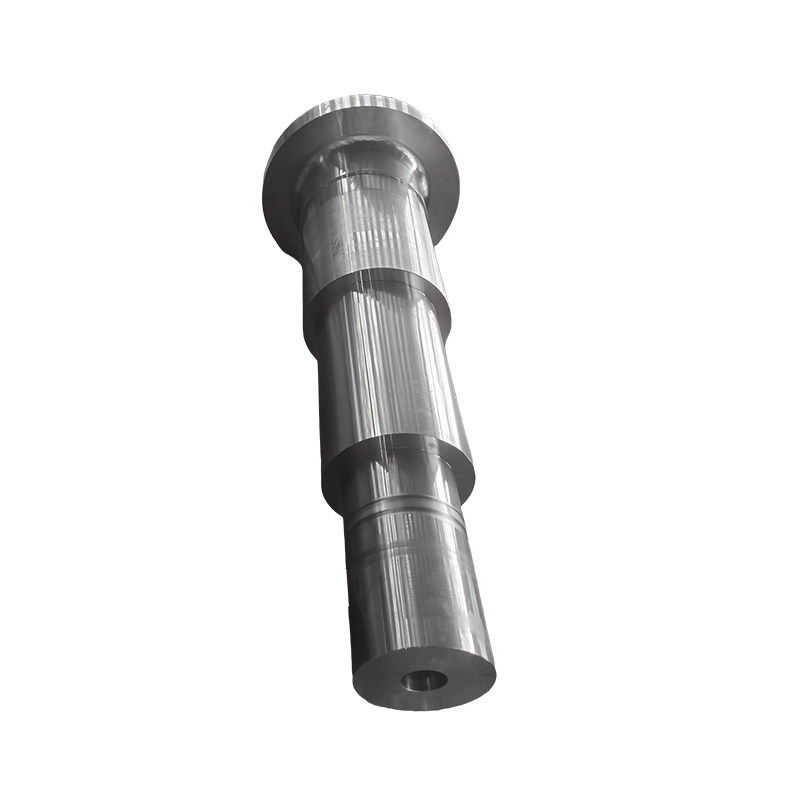
Mechanical Property Comparison: Forging vs. Casting by the Numbers
The mechanical property differences between forged and cast marine shafts are not marginal — they are substantial and well-documented in both materials science literature and classification society data accumulated over decades of fleet experience.
| Property | Forged Carbon Steel Shaft | Cast Carbon Steel Shaft | Forging Advantage |
|---|---|---|---|
| Tensile Strength (UTS) | 600 – 800 MPa | 450 – 620 MPa | +20 to +40% |
| Yield Strength (0.2% proof) | 350 – 550 MPa | 230 – 380 MPa | +30 to +50% |
| Fatigue Limit (endurance) | 280 – 380 MPa | 180 – 260 MPa | +30 to +50% |
| Charpy Impact Toughness | 60 – 120 J (at 0°C) | 20 – 50 J (at 0°C) | +100 to +200% |
| Elongation at Break | 18 – 25% | 10 – 16% | +40 to +60% |
| Reduction of Area | 40 – 60% | 15 – 30% | +80 to +150% |
| Internal Defect Frequency | Very low (closed porosity) | Moderate to high (inherent) | Significantly lower |
The fatigue limit advantage is particularly significant for marine shaft applications. A shaft that survives 10 million cycles at a given stress amplitude in forged form may fail after as few as 2–3 million cycles if cast — a difference that translates directly into service life, inspection intervals, and the risk of catastrophic in-service failure at sea.
Impact toughness is also critical for shafts that may experience shock loading — from propeller blade strikes against ice, debris, or the consequences of emergency engine maneuvers. The Charpy toughness advantage of forged shafts (often double or triple the values of cast equivalents) means forged shafts absorb and dissipate impact energy through plastic deformation rather than brittle fracture, a survival difference that can prevent shaft failure and consequent vessel loss.
Marine Shaft Service Conditions: Why These Differences Matter So Much
To fully appreciate why the mechanical property differences between forged and cast shafts translate into real-world consequence for marine vessels, it is necessary to understand the severity and complexity of the loading environment that marine propulsion shafting must survive.
Combined Cyclic Loading
A marine propulsion shaft does not experience simple static loading. At any given moment, it is simultaneously carrying:
- Torsional loading from the transmission of engine torque to the propeller — the primary design load, cycling with every power fluctuation and revolution.
- Bending moments from the weight of the shaft and propeller, hydrodynamic forces on the propeller blades, and misalignment between bearing supports — producing a rotating bending stress that cycles once per revolution.
- Axial thrust transmitted from the propeller through the shaft to the thrust bearing — sustained in normal operation and varying with vessel speed and sea state.
- Transient shock loads from propeller cavitation, blade damage, ice encounter, or rapid engine maneuvers that superimpose high-amplitude transient stresses onto the sustained loading.
For a vessel operating at 120 RPM (typical of a large slow-speed diesel direct drive), the shaft experiences approximately 63 million stress cycles per year from rotating bending alone. Over a 25-year service life, this accumulates to well over one billion cycles — deep into the high-cycle fatigue regime where the fatigue limit of the material, not its ultimate tensile strength, governs survival.
Corrosive Environment
Marine shafts operate in or near seawater — one of the most corrosive environments encountered in engineering practice. Seawater contains approximately 3.5% dissolved sodium chloride by weight, along with sulfates, carbonates, dissolved oxygen, and biological agents including sulfate-reducing bacteria that accelerate localized corrosion. The combination of cyclic stress and corrosive environment creates corrosion fatigue — a failure mechanism more severe than either factor alone — where corrosive attack preferentially targets the tip of any growing fatigue crack, dramatically accelerating crack growth rate.
The dense, defect-minimized structure of forged shafts offers better resistance to corrosion fatigue initiation than cast shafts, which may contain surface-breaking or near-surface porosity and inclusions that provide preferential sites for corrosive attack and crack initiation.
Stern Tube and Bearing Fretting
In the way of stern tube bearings and propeller boss fits, marine shafts experience fretting — a form of surface fatigue caused by micro-motion at the contact interface under combined normal and oscillatory shear forces. Fretting generates stress concentrations and surface damage that dramatically reduce fatigue strength at precisely the locations subject to the highest bending stresses. The higher surface hardness and microstructural integrity of forged shafts provide better resistance to fretting damage than cast equivalents.
Classification Society Requirements: The Regulatory Verdict
The world's major marine classification societies — organizations that establish technical standards for ship construction and provide third-party verification of compliance — have reached a clear consensus on shaft manufacturing requirements based on decades of accumulated failure data and theoretical analysis.
Rules published by major classification bodies universally require that main propulsion shafts — including propeller shafts, intermediate shafts, and thrust shafts — be manufactured from forged steel. This requirement is not presented as a preference or a recommendation; it is a binding technical requirement for class certification. Vessels with cast main propulsion shafts would not receive class certification from any major classification society under current rules.
Typical classification society requirements for marine shaft forgings specify:
- Manufacture from carbon steel, carbon-manganese steel, or alloy steel by the open-die or closed-die forging process, with specific chemical composition limits to ensure adequate hardenability and toughness.
- Normalized, normalized and tempered, or quenched and tempered heat treatment condition, with the specific treatment determined by the shaft grade and diameter.
- Minimum tensile strength, yield strength, elongation, and Charpy impact energy at specified test temperatures — with test specimens taken from positions and orientations that represent the properties of the finished shaft cross-section.
- Non-destructive testing (NDT) by ultrasonic examination to verify internal soundness, with acceptance criteria that limit the size and frequency of permissible indications — criteria that cast shafts would routinely fail to meet.
- Witnessing of mechanical testing and inspection by a classification society surveyor at the forge, providing third-party verification of compliance before the shaft is accepted into the supply chain.
The forging requirement is not new or recently derived from operating experience — it has been embedded in classification rules for well over a century, reflecting the accumulated engineering judgment of the marine industry that for rotating power transmission shafts under sustained cyclic loading, forging is the appropriate manufacturing process.
The Forging Process for Marine Shafts: Open-Die vs. Closed-Die
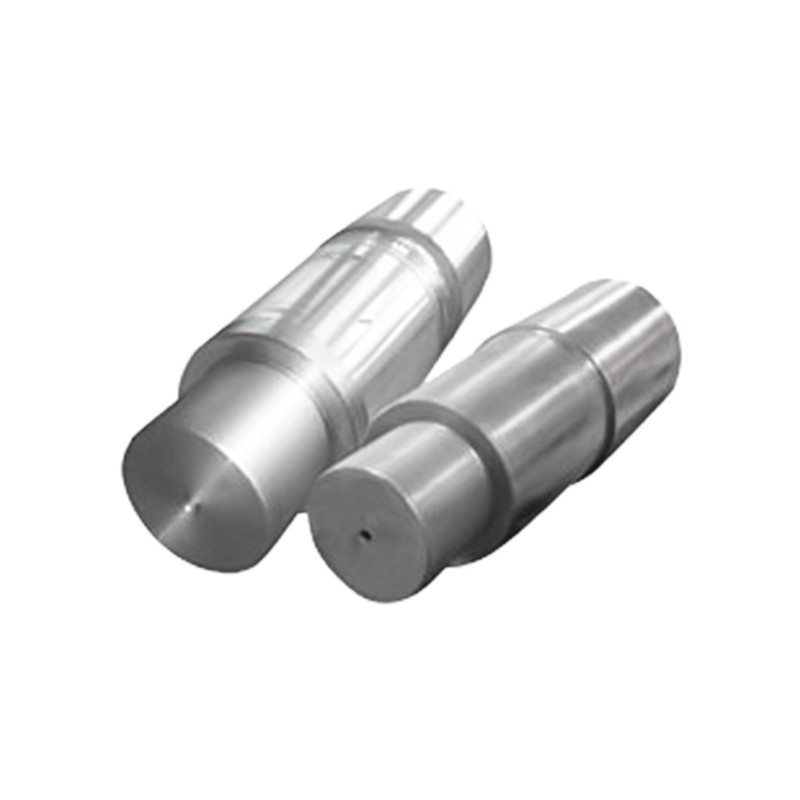
Marine propulsion shafts are predominantly produced by the open-die forging process, which is the most appropriate method for the large diameters, long lengths, and relatively simple cross-sectional geometry that characterize main shafting. Understanding this process clarifies why forged shafts have the properties they do.
Open-Die Forging of Marine Shafts
In open-die forging, the heated steel ingot is worked between flat or shaped dies on a hydraulic press or hammer, with the workpiece progressively repositioned to achieve the desired shape and achieve mechanical working throughout the cross-section. For a large marine shaft, this process involves:
- Ingot preparation: A cast steel ingot of appropriate weight — which may range from a few tonnes for small shafts to over 100 tonnes for the largest vessel shafts — is cropped to remove the ingot head (which contains segregation and shrinkage) and the tail, ensuring only sound material is worked.
- Heating: The ingot is heated uniformly to the forging temperature — typically 1,100°C to 1,250°C for carbon and low-alloy steels — sufficient for plastic deformation without incipient melting of grain boundaries.
- Cogging (drawing out): The ingot is systematically reduced in cross-section by progressive hammer or press blows while being rotated and advanced, elongating the grain structure along the shaft axis and closing internal porosity from the original cast ingot.
- Profiling: The shaft features — flanges, journal diameters, steps — are formed to near-final dimensions, with material distributed to the appropriate sections while maintaining working throughout.
- Heat treatment: Following forging, the shaft is heat-treated to achieve the required mechanical properties — normalized and tempered for standard grades, or quenched and tempered for higher-strength alloy grades.
A critical parameter in marine shaft forging quality is the forging ratio — the ratio of original ingot cross-sectional area to final forged section area, or equivalently the ratio of ingot length to final shaft length. A minimum forging ratio of 3:1 to 5:1 is typically specified for quality marine shaft forgings, ensuring sufficient mechanical working to fully eliminate cast structure and achieve uniform, refined grain throughout the cross-section. Shafts forged at inadequate reduction ratios retain remnant cast structure that compromises properties.
Ring Rolling for Flanged Shaft Components
For flanged shaft components and coupling rings, ring rolling — a specialized forging variant — produces seamless forged rings with circumferential grain flow aligned with the hoop stress direction. Ring-rolled flanges provide significantly better mechanical properties than flanges machined from bar stock or manufactured as weld-attached plate rings, and are standard for quality marine shaft flange couplings on vessels classed with major classification societies.
Material Grades for Marine Shaft Forgings
Marine shaft forgings are produced in a range of steel grades, selected based on shaft diameter, power transmission requirements, vessel type, and classification society grade designation. The choice of alloy grade is a significant engineering decision that affects not just mechanical properties but also machinability, weldability, and cost.
| Grade Category | Typical Alloy | Min. UTS (MPa) | Heat Treatment | Typical Application |
|---|---|---|---|---|
| Carbon Steel (S1) | C35 / C40 / C45 | 500 – 600 | Normalized / N+T | Auxiliary shafts, small vessels |
| Carbon-Manganese (S2) | C40Mn / 42CrMo4 | 600 – 700 | N+T or Q+T | Intermediate shafts, medium vessels |
| Alloy Steel (S3) | 34CrNiMo6 / 30CrNiMo8 | 700 – 850 | Q+T | Main propeller shafts, large vessels |
| High-Strength Alloy | 40NiCrMo / 35NiCrMoV | 850 – 1,000+ | Q+T | Naval vessels, high-performance craft |
| Duplex Stainless | 2205 / 2507 | 620 – 800 | Solution annealed | Corrosion-critical applications |
The selection of alloy grade interacts with shaft diameter in an important way. As shaft diameter increases, the ability to achieve fully through-hardened properties by quenching diminishes — a phenomenon called mass effect or hardenability limitation. For large-diameter shafts, alloy steels containing chromium, nickel, and molybdenum are specified specifically because their higher hardenability allows adequate mechanical properties to be achieved throughout the full cross-section even at diameters exceeding 500mm. Carbon steel shafts larger than approximately 250mm in diameter cannot be fully through-hardened by quenching and therefore rely on normalized and tempered properties that are somewhat lower than through-hardened alloy steel equivalents.
Non-Destructive Testing: How Quality Is Verified
The mechanical properties of a forged marine shaft are verified destructively on test specimens cut from representative test pieces forged alongside or at the ends of the actual shaft. But because destructive testing cannot be performed on the shaft itself, non-destructive testing (NDT) is used to verify the internal and surface integrity of every shaft before delivery.
Ultrasonic Testing (UT)
Ultrasonic testing is the primary NDT method for verifying the internal soundness of marine shaft forgings. High-frequency sound waves (typically 1–5 MHz) are introduced into the shaft and reflections from internal discontinuities — voids, cracks, inclusions, laminations — are detected by the probe. Modern phased array ultrasonic testing (PAUT) can produce detailed cross-sectional images of internal shaft quality and detect indications as small as 2–3mm in diameter at depths of several hundred millimeters, enabling rejection of any shaft with unacceptable internal defects before machining, delivery, or installation.
Magnetic Particle Testing (MT) and Liquid Penetrant Testing (PT)
Surface and near-surface defects are detected using magnetic particle testing on ferritic steel shafts — where a magnetic field induces flux leakage at surface-breaking discontinuities, attracting magnetic particles to reveal their location — or liquid penetrant testing for austenitic stainless steel shafts. These methods detect surface cracks, laps, seams, and forging folds that could initiate fatigue cracks in service but may not be visible to the naked eye after machining.
Dimensional and Surface Inspection
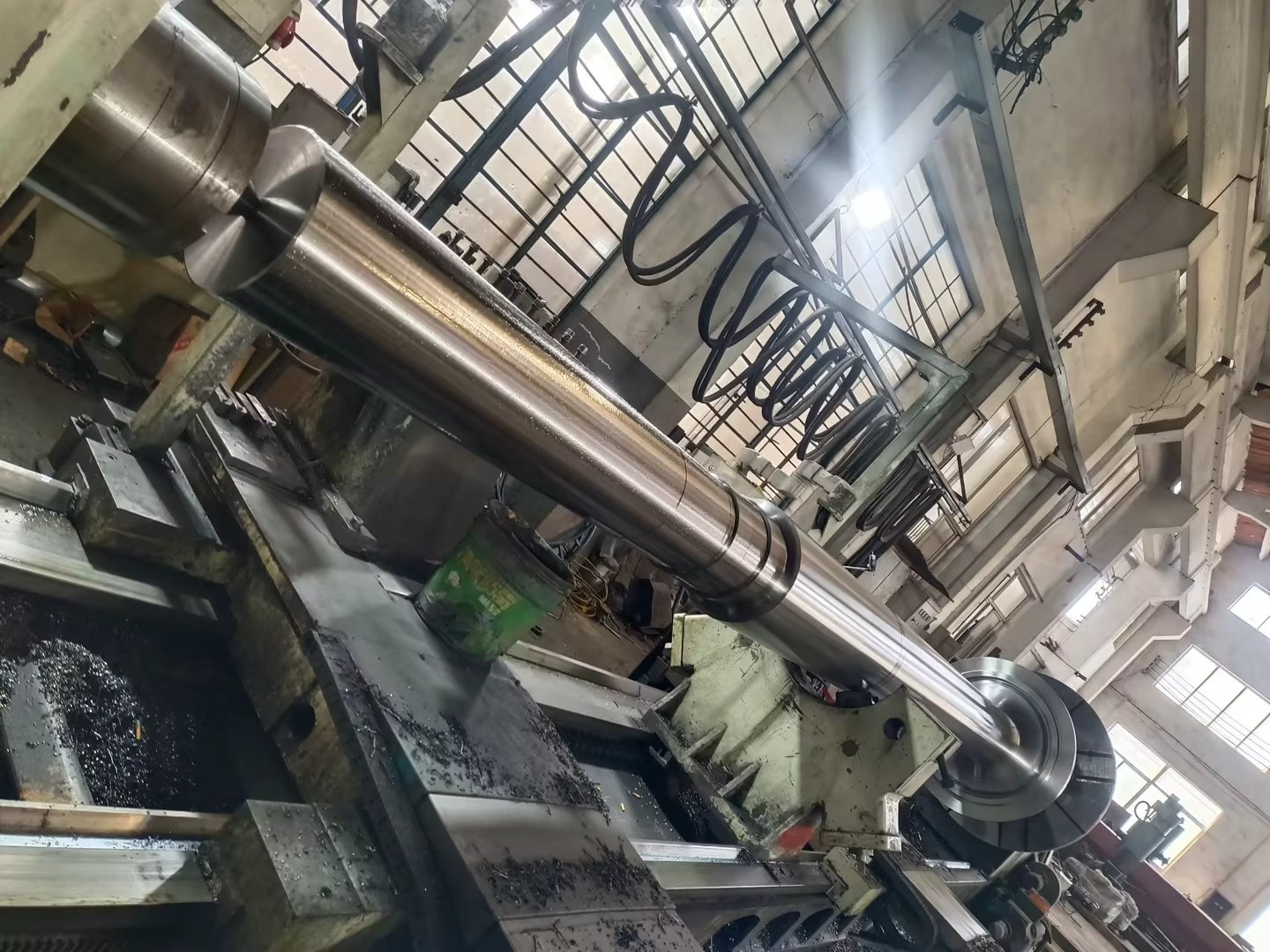
Before final acceptance, finished shafts are dimensionally inspected to verify conformance with drawing tolerances — bearing journal diameters are typically held to h6 or h7 tolerances (approximately ±0.01 to ±0.03mm on typical journal diameters), and surface roughness at bearing surfaces is specified and measured to confirm adequate lubrication film formation in service.
Where Cast Components Remain Applicable in Marine Shaft Systems
While cast steel is not acceptable for main propulsion shafts, casting processes retain legitimate applications in marine shaft system components — primarily where complex geometry is required and the loading demands are lower than those on the shaft itself.
- Propeller castings: Marine propellers are typically manufactured as cast nickel-aluminum bronze (NAB) or manganese-aluminum bronze (MAB) components. The complex blade geometry of a propeller — with three-dimensional hydrofoil cross-sections varying from root to tip — is not practically producible by forging, and the casting alloys used are specifically optimized for corrosion resistance and cavitation resistance rather than the high-cycle fatigue performance needed in the shaft itself.
- Stern tube and bearing housings: The stern tube that contains and supports the shaft through the hull is typically a cast iron or steel casting. The loading on the stern tube is primarily compressive and static rather than cyclic torsional, and its complex geometry — with flanges, seal faces, and bearing bores — is well-suited to casting.
- Gear cases and reduction gear housings: The housings that enclose marine reduction gearboxes are cast iron or cast steel components where the primary function is structural enclosure and bearing support under relatively static loads.
- Low-speed auxiliary shafting: In some auxiliary systems — windlass shafts, crane drives, low-power pump drives — the load levels are sufficiently low that cast steel or cast iron components may be acceptable under classification rules. These applications do not involve the sustained high-cycle fatigue environment of main propulsion.
The common thread in all legitimate casting applications within marine shaft systems is that they involve either non-rotating static structural components, complex geometries incompatible with forging, or load levels dramatically lower than main propulsion shafting. The shaft itself — the rotating power transmission element — is always forged.
Cost Considerations: Understanding the True Economics
It is sometimes argued that cast shafts could offer a cost advantage over forged equivalents. A rigorous analysis of the full cost picture — encompassing material, manufacture, testing, installation, maintenance, and operational risk — consistently demonstrates that this apparent saving is illusory for main propulsion applications.
Initial Cost Comparison
Casting a shaft is indeed cheaper than forging one when only the primary forming step is considered. Casting requires no expensive forging press time, and the per-piece cost of casting tooling (patterns and molds) is lower than forging die costs for small production volumes. However, this initial cost comparison ignores the extensive NDT required for cast shafts to detect inherent casting defects — ultrasonic scanning of a large casting is time-consuming and expensive — and the higher rejection rate from casting defects that may disqualify a casting after significant machining work has already been invested.
Lifecycle and Risk Cost
The dominant cost argument for forged marine shafts is not the unit manufacturing cost — it is the cost of failure. A propulsion shaft failure at sea can involve:
- Emergency dry-docking, with drydocking costs for large vessels ranging from $500,000 to over $5,000,000 per event depending on port, vessel size, and repair scope.
- Revenue loss from the vessel being off-hire during repair, which for a large container ship or bulk carrier can amount to $30,000 to $100,000 per day.
- Replacement shaft cost and fabrication lead time — a large marine shaft forging may require 8 to 16 weeks for manufacture and delivery, extending the off-hire period substantially.
- In catastrophic failures, the risk of loss of vessel control, grounding, collision, crew injury, and environmental pollution — liabilities that dwarf any material cost consideration.
Against this cost-of-failure backdrop, the premium for a forged shaft over a hypothetical cast equivalent is economically trivial — and in any case, the question is largely academic because classification society rules make cast main propulsion shafts a non-compliant option for certificated vessels.
Key Quality Factors When Sourcing Marine Shaft Forgings
For shipbuilders, naval architects, ship operators, and procurement professionals sourcing marine shaft forgings, the following quality factors should be verified before accepting any shaft into a project or fleet.
| Quality Factor | What to Verify | Why It Matters |
|---|---|---|
| Material Certification | Mill certificate with full chemical analysis and heat number traceability | Confirms specified alloy was used |
| Forging Ratio | Minimum 3:1 for standard grades; 5:1 for critical applications | Ensures cast structure fully broken down |
| Heat Treatment Records | Time-temperature charts for N+T or Q+T cycle | Verifies properties are from correct treatment |
| Mechanical Test Results | UTS, YS, elongation, RA, and Charpy at specified temperature | Confirms compliance with class grade requirements |
| Ultrasonic Inspection Report | Full-length UT scan results with acceptance criteria reference | Confirms internal soundness |
| Surface NDT Report | MT or PT examination of bearing surfaces and keyways | Confirms freedom from surface-breaking defects |
| Class Surveyor Certificate | Original classification society certificate with surveyor stamp | Third-party verification of compliance |
| Dimensional Inspection | Journal diameters, runout, surface finish at bearing faces | Confirms fit to bearings and couplings |
Traceability from raw ingot through forging, heat treatment, and testing to the finished shaft is a non-negotiable requirement for classification-society-compliant marine shafts. Any gap in this traceability chain — an undocumented heat treatment, a missing mill certificate, mechanical test results not witnessed by a class surveyor — should result in rejection of the shaft regardless of its apparent physical condition.
Direct Comparison Summary: Forged vs. Cast Marine Shafts
The following table consolidates the full comparison between forged and cast marine shafts across all relevant dimensions for a final side-by-side evaluation.
| Evaluation Criterion | Forged Shaft | Cast Shaft | Winner |
|---|---|---|---|
| Tensile and yield strength | Superior — aligned grain, worked structure | Lower — random equiaxed grain | Forged |
| Fatigue resistance | 30–50% higher fatigue limit | Lower — defects accelerate initiation | Forged |
| Impact toughness | 100–200% higher Charpy energy | More brittle, especially at low temperature | Forged |
| Internal soundness | Excellent — closed porosity, no voids | Inherent porosity and segregation | Forged |
| Classification compliance | Fully compliant — required by all major societies | Non-compliant for main propulsion | Forged |
| Geometric complexity | Limited to simpler cross-sections | Can produce complex internal features | Cast |
| Unit forming cost (simple geometry) | Higher | Lower initial cost | Cast (initial only) |
| Total lifecycle cost | Lower — longer service life, fewer failures | Higher failure risk costs dominate lifecycle | Forged |
| Corrosion fatigue resistance | Better — denser structure, fewer initiation sites | Surface defects accelerate attack | Forged |
The conclusion is unambiguous: for marine propulsion shafting, forging is not just the better choice — it is the only appropriate choice, both from an engineering performance perspective and from a regulatory compliance standpoint. The question of forged versus cast marine shafts is settled for main propulsion applications, and has been settled by the engineering community and classification societies for over a century of practical experience with vessel propulsion systems at sea.

Message Us Right Now!
-
Mobile Terminal
-
Quick Links
Products About Us Equipment & Capacity Quality News Contact Us -
Product Category
Power‑Generation Forgings OEM Machined Forgings CUSTOMIZED MADE FORGING PARTS Ship and Port Machinery Forgings Mining and Metallurgy Forgings Food and Feed Machinery Forgings Welding Fabrication Petrochemical Industry Forgings -
Contact Us
Mob.: +86-173 7218 0878 Tel.: +86-515-8389 0396 E-mail: ivy.zhai@aceprocess.cn Add.: No.21 Jinfeng Road, Economic Development Park, Dafeng District, Yancheng City, Jiangsu, China
Copyright © 2025 Yancheng ACE Machinery Co., Ltd. All Rights Reserved.
China open die forgings manufacturer
custom precision forgings supplier
