

 English
 中文简体
中文简体

Industry News
Home / News / Industry News / Seamless Rolled Ring Forgings: Process, Tolerances, Materials and Buying Guide
 Home / News / Industry News / Seamless Rolled Ring Forgings: Process, Tolerances, Materials and Buying Guide
Industry News
Seamless Rolled Ring Forgings: Process, Tolerances, Materials and Buying Guide
2026-10-09
A 1.4 m gear blank arrives at your machining cell with a faint line running around its circumference. Dye penetrant shows nothing. Ultrasonic testing does, and it is either a weld seam or a string of inclusions that was rolled into a plate. The ring is rejected at first article, the assembly schedule slips two weeks, and purchasing asks a fair question: could we have avoided this?
In most cases, yes. Anything that rotates under load, retains pressure or carries torque should be specified as a seamless rolled ring forging rather than a ring cut from plate or welded up from bar. What follows explains what that choice changes, how the process runs, and what to write on the drawing so the first part you receive is a part you can use.
Content
What the word seamless actually changes in the part
Seamless describes geometry, not marketing. A seamless rolled ring has no circumferential weld, and its grain flow runs around the circumference instead of across the wall. Those two facts drive nearly every difference a buyer will notice.
- Continuous circumferential grain flow, which lines up with the hoop stress a gear ring, bearing race or pressure retaining ring actually sees.
- No weld seam, so there is no built in crack initiation site and no heat affected zone sitting in the highest stress region of the part.
- No through thickness plate anisotropy, so mechanical properties stay more uniform around the ring.
- Fewer ultrasonic indications and a simpler inspection routine, which usually shortens first article approval.
- Better material utilization. Once the outside diameter passes roughly one meter, cutting a ring from plate wastes a large share of the plate.
How the seamless rolled ring process runs
There is no seam to begin with, so there is nothing to hide. The ring starts as a punched donut that grows in diameter while its wall thins.
Billet preparation, upsetting and punching
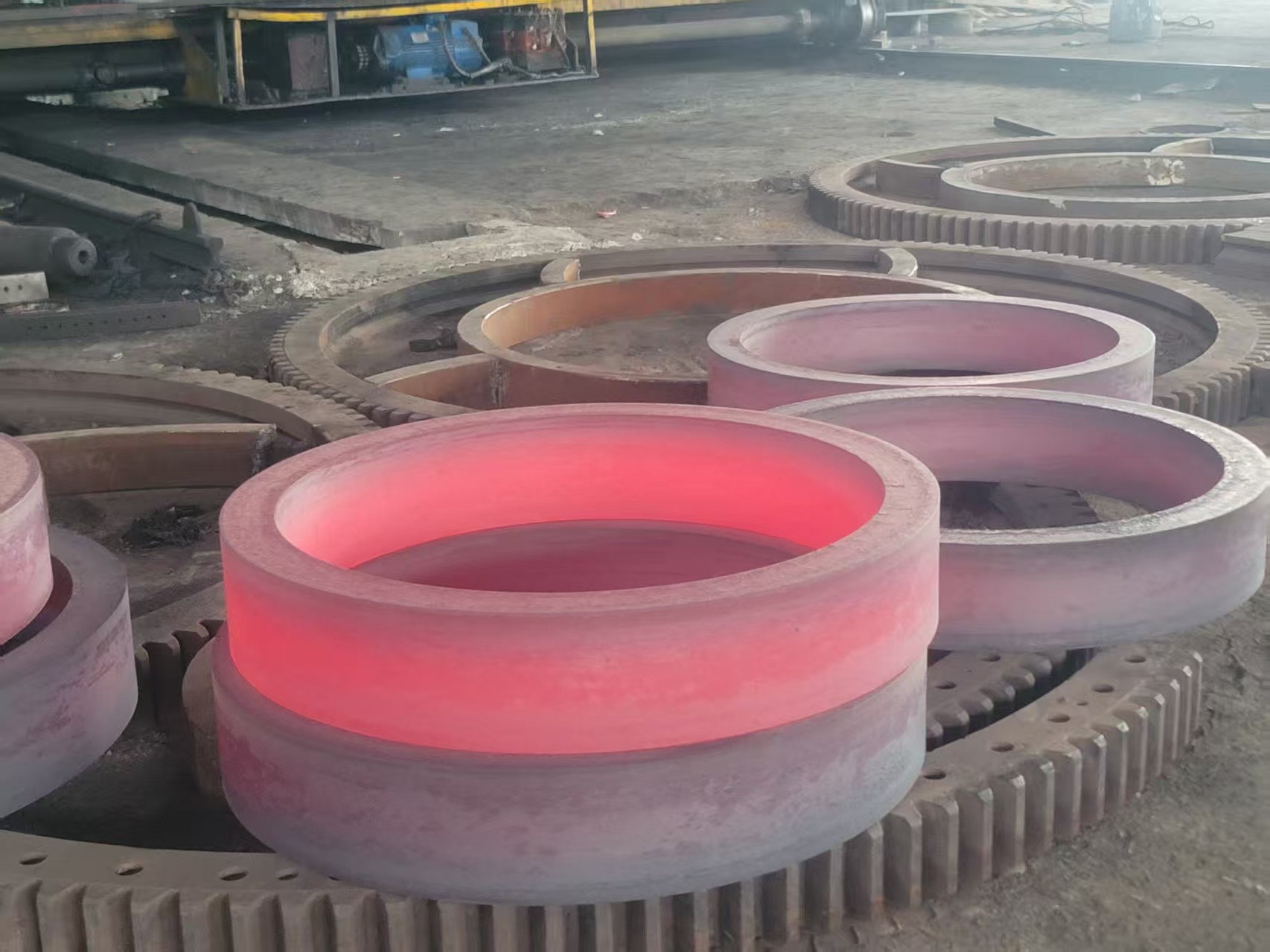
Stock is cut to weight, heated to forging temperature, upset to consolidate the centre, then punched to open a hole. The result is a thick walled donut with plenty of material still to move.
Radial and axial rolling
The donut sits between a driven main roll and an idler roll while two axial rolls control height. Each pass increases diameter and reduces wall thickness. Because deformation is continuous, grain flow follows the circumference and internal porosity closes. The operator balances radial and axial reduction so the ring stays round and flat instead of coning or ovalizing.
Heat treatment, testing and machining
After rolling, the ring is normalized, austenitized, quenched and tempered to the specified condition, then inspected and machined. Rough turning is normally done before final heat treatment and finishing after it, so distortion is removed where it matters.
Comparing the routes for large rings
Rolling is not the only way to make a ring. It is simply the route that keeps grain flow continuous, and the table below shows where that matters most between roughly 300 mm and 3,000 mm outside diameter.
| Route | Grain flow | Wall thickness fit | Typical use | Main risk |
|---|---|---|---|---|
| Seamless rolled ring forging | Continuous around the circumference | Moderate to heavy walls | Gear rings, slewing bearings, flanges, pressure parts | Rolling capacity and tooling lead time |
| Ring cut from plate | In plane, interrupted at the edges | Thin walls and low heights | Spacers, covers, low load rings | Anisotropy and high scrap rate |
| Welded ring from plate or bar | Interrupted at the weld | Any, but the weld governs | Ducts and shrouds that do not rotate | Weld defects, heat affected zone, inspection cost |
| Sand casting | Random | Heavy sections | Large low stress housings | Porosity and lower fatigue strength |
| Open die forging plus boring | Radial, partly axial | Very heavy walls, smaller diameter | Shafts and discs | More machining stock and looser wall control |
What to put on the drawing
Ring rolling is a constant volume process, so every dimension interacts. The details below are the ones that most often cause a first article to fail.
- Outside diameter, inside diameter, height and wall thickness with tolerances. Control wall thickness explicitly, not only outside diameter.
- Height to wall ratio. Ratios up to about 4 to 1 roll cleanly; very flat, thin rings are harder to keep flat.
- As rolled or machined condition. As rolled rings usually leave 3 mm to 8 mm of stock per surface depending on diameter.
- Concentricity and flatness, because a rolled ring can drift oval before the final pass.
- Material grade, heat treatment condition, hardness range and where hardness is measured.
- Ultrasonic acceptance level and the reference standard to test against.
- Grain flow or macroetch requirement for the first article when fatigue life is critical.
Materials and heat treatment
Carbon and alloy steels cover most ring work: 1045, 4140 and 42CrMo4, 34CrNiMo6, and similar grades where strength and hardenability matter. Stainless grades such as 304, 316L, 17-4PH and 420 appear where corrosion resistance or wear resistance drives the design, particularly in food and feed machinery and in pump and valve parts. If a stainless ring is on the table, the basics of stainless steel forgings are worth reviewing before the grade is frozen, because stainless steels respond differently to heating, deformation and cooling than carbon steels do.
Forging sets the grain flow, but heat treatment sets the properties. Normalizing refines the structure after rolling, quenching and tempering establish strength and toughness, and induction hardening is often applied afterwards to gear teeth and wear surfaces. Holding a narrow hardness band across a large ring is the part of the job that separates a capable supplier from a busy one.
Where rolled rings earn their cost
Wind turbine gearboxes are the clearest case. Ring gears, sun gears and planet carriers in 3 MW to 10 MW platforms see reversing loads for twenty years, and a circumferential weld has no place in that duty cycle.
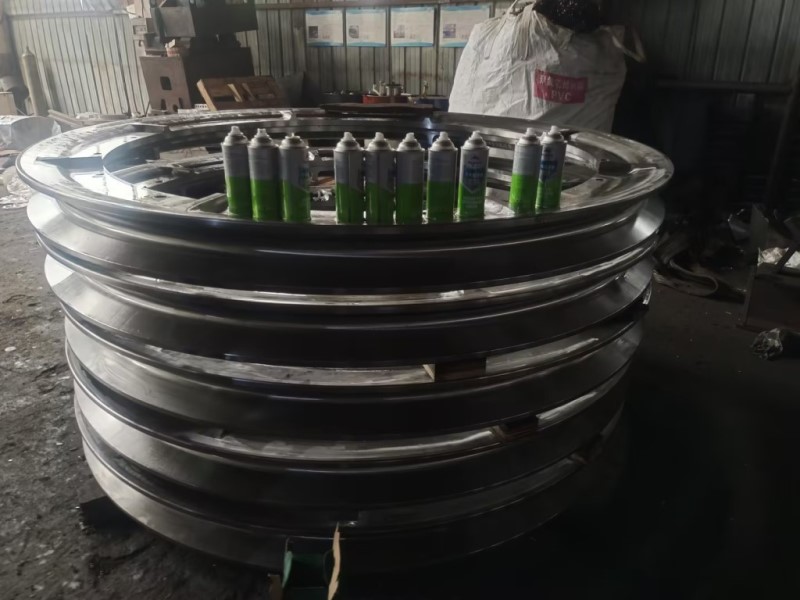
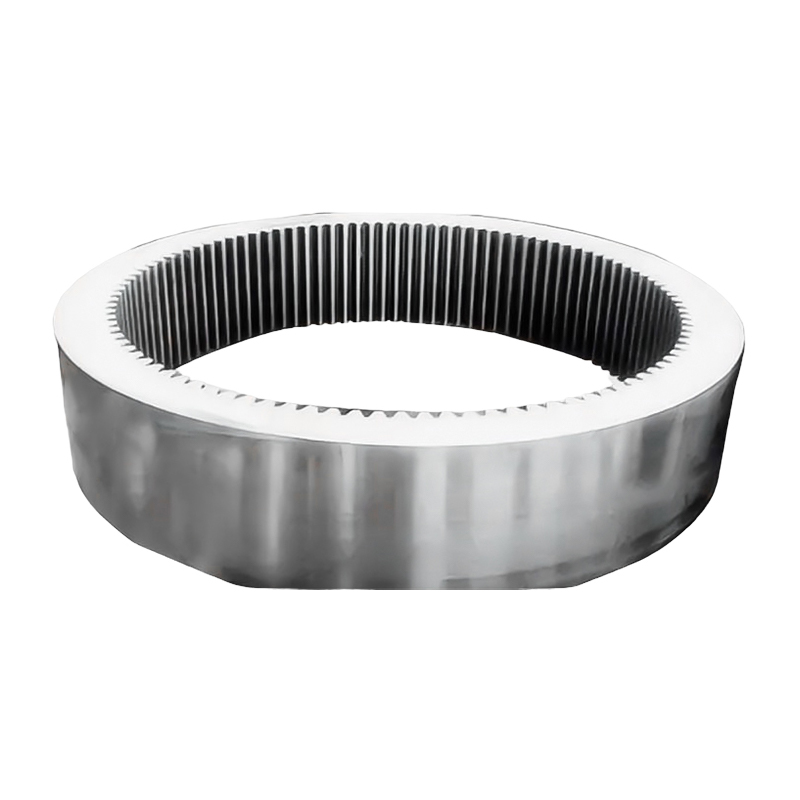 Wind Turbine Ring Gear Forgings for 5-10 MW GearboxesRing-rolled forgings for 5-10 MW wind turbine main gearboxes, supporting planetary transmission and precision-ground tooth profiles for stable torque transmission.View Product →
Slewing bearings and flanged rings used on cranes, port equipment and excavators follow the same logic. The ring carries the full load path of the machine, and a rolled ring gives a uniform section that handles shock loading better than a cut or welded alternative.
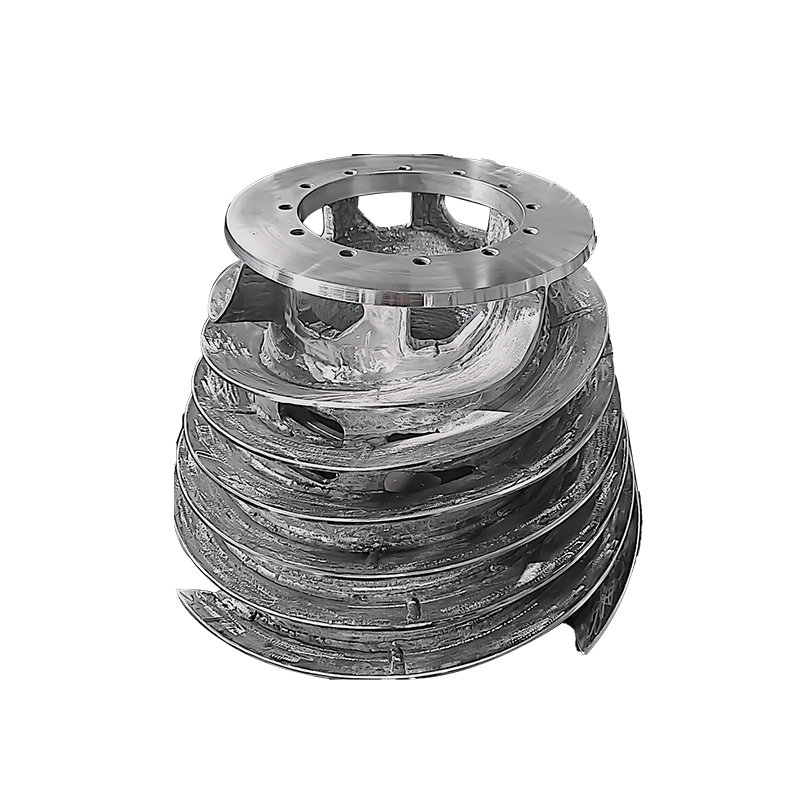
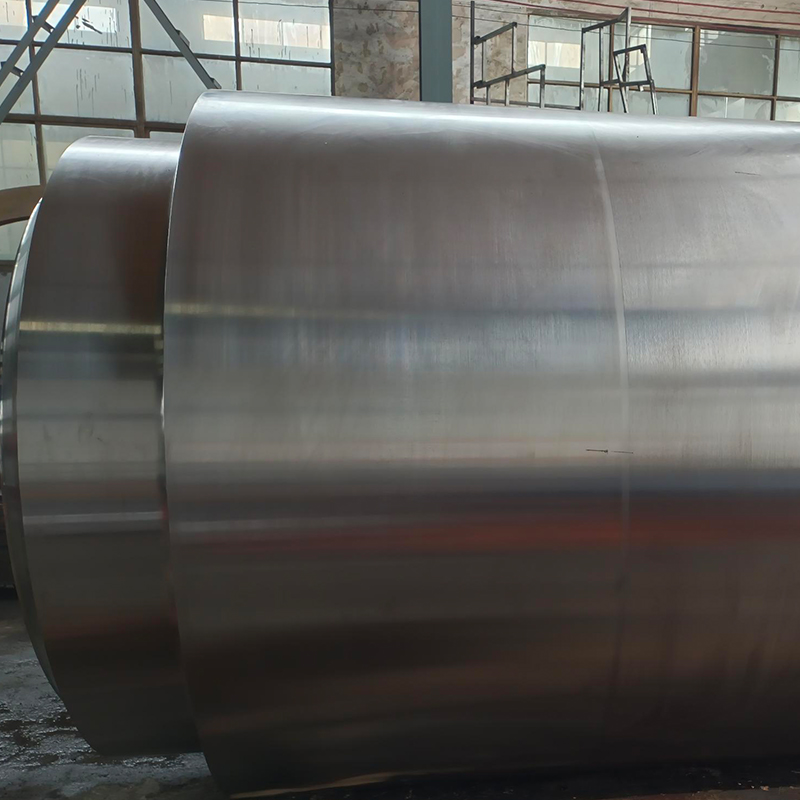 Slewing Bearing Forgings for Ship and Port MachineryForged slewing rings for shipboard tanks, exhaust and cooling lines, and port machinery, with stable structure and reliable sealing in demanding conditions.View Product →
Pressure retaining parts are another fit: tube sheets, valve bodies, casing heads and wellhead components all gain from the absence of internal defects. Food and feed machinery uses stainless rings and wear parts, where corrosion resistance and hygiene matter as much as strength. When a design falls outside standard sizes, a custom route is usually cheaper than redesigning the assembly around a catalogue ring.
A sourcing checklist for rolled ring forgings
Price comparisons between a rolled ring and a welded ring are rarely apples to apples, because the welded ring hides welding, inspection and rework in the total cost. Ask these questions before the purchase order goes out.
- What ring rolling mills do you run? Vertical mills in the 1 m and 1.5 m class hold wall and height control that a hammer shop without rolls cannot offer.
- What is the maximum billet weight and ring diameter you can handle? This decides whether your finished outside diameter is realistic.
- Is heat treatment done in house? Normalizing furnaces, quench tanks, tempering furnaces and induction hardening equipment decide whether the values on the drawing are repeatable.
- What does the first article package include? Ask for a dimensional report, ultrasonic report, material certificate and, where fatigue life is critical, a macroetch showing grain flow.
- Can the supplier finish the part? A near net ring still needs turning, boring and gear cutting, and sometimes welded assemblies joined to a rolled ring. Fewer hand offs means fewer chances for a tolerance to be lost.
ACE Group in Yancheng, Jiangsu runs this kind of integrated chain. Its core production base covers 55 acres with more than 50,018 square meters of floor area and was commissioned in November 2025. The equipment list includes 3 tonne, 5 tonne and 15 tonne electro hydraulic hammers, 1 m and 1.5 m vertical ring rolling mills, gas fired heating furnaces, heat treatment resistance furnaces, quench tanks, induction hardening units and machining centres, with welding fabrication and a heavy duty paint line downstream.
For rings that rotate under load, retain pressure or take repeated shock, seamless rolled ring forgings are the default answer rather than an upgrade. Settle the wall thickness, the machining allowance and the inspection level early, put them on the drawing, and confirm that the supplier can roll, heat treat and finish the ring in house. That combination removes most of the reasons a first article fails, and it removes the weld seam that started the conversation in the first place.

Message Us Right Now!
-
Mobile Terminal
-
Quick Links
Products About Us Equipment & Capacity Quality News Contact Us -
Product Category
Power‑Generation Forgings OEM Machined Forgings CUSTOMIZED MADE FORGING PARTS Ship and Port Machinery Forgings Mining and Metallurgy Forgings Food and Feed Machinery Forgings Welding Fabrication Petrochemical Industry Forgings -
Contact Us
Mob.: +86-173 7218 0878 Tel.: +86-515-8389 0396 E-mail: ivy.zhai@aceprocess.cn Add.: No.21 Jinfeng Road, Economic Development Park, Dafeng District, Yancheng City, Jiangsu, China
Copyright © 2025 Yancheng ACE Machinery Co., Ltd. All Rights Reserved.
China open die forgings manufacturer
custom precision forgings supplier
