

 English
 中文简体
中文简体

Industry News
Home / News / Industry News / Wind Turbine Forging Market: Gearbox Forgings, Specs and Sourcing Guide
 Home / News / Industry News / Wind Turbine Forging Market: Gearbox Forgings, Specs and Sourcing Guide
Industry News
Wind Turbine Forging Market: Gearbox Forgings, Specs and Sourcing Guide
2026-10-15
A gearbox manufacturer wins a 6 MW offshore platform order, then finds that no approved supplier can roll a 1.5 m ring gear in 18CrNiMo7-6 inside a 14 week window. The turbine order was never the risk. The forging was. In the wind turbine forging market, the deciding variable is rarely headline demand for clean energy. It is whether large, heat treated, ultrasonically tested components can be produced on schedule and to specification.
This guide sets out what the market buys, where capacity tightens, and which technical checks separate an acceptable forging from an expensive reject.
Content
- 1 What the Market Actually Buys
- 2 Why Forgings Keep Getting Larger
- 3 Specifications That Decide Acceptance
- 4 Typical Wind Drivetrain Forgings at a Glance
- 5 Ring Rolling Capacity Is Often the Real Constraint
- 6 What to Verify Before Placing an Order
- 7 Where Cost and Risk Concentrate
- 8 How ACE Group Supports Wind Gearbox Programs
What the Market Actually Buys
The forged content of a modern turbine sits in four groups:
- Gearbox internals: planet carriers, planet gears, sun gears, ring gears and intermediate shafts.
- Main drivetrain: forged main shafts, coupling flanges and bearing housings.
- Tower and yaw system: forged tower flanges, yaw and pitch bearing rings, and slewing rings.
- Nacelle hardware: hub components, brake discs and high load fasteners.
These parts are forged rather than cast for consistent reasons: grain flow follows the load path, fatigue behaviour under cyclic torque is more predictable, and internal defects can be sized by ultrasonic testing. That last point is commercial, not academic. A casting with an unacceptable porosity indication is often scrapped late in machining, after most of the value has already been added.
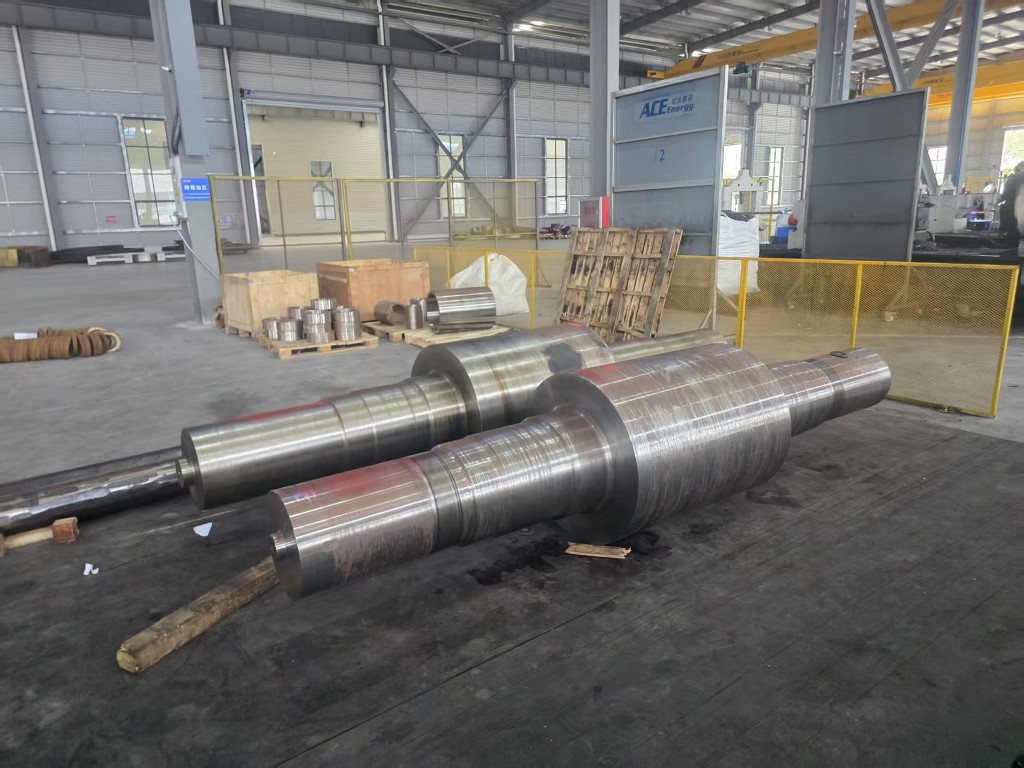 3MW–10MW Wind Turbine Planet Carrier ForgingsForged planet carriers for 3–10 MW wind gearboxes, with 18CrNiMo7-6/42CrMo4 options and UT, PT, MPI testing for heavy-duty load paths.View Product →
Why Forgings Keep Getting Larger
Rated power scales steeply with rotor diameter, and torque scales with swept area and gear ratio. The practical result is that a 3 MW gearbox and a 10 MW gearbox do not differ by a factor of three in component size. They differ by a much larger factor in ring diameter, wall thickness and single piece weight. Planet carriers that were once below one tonne now routinely exceed two to three tonnes on offshore platforms.
Larger forgings press against three limits at the same time:
- Ingot and billet size, which caps the cross section that can be upset or drawn.
- Available forging energy, expressed as hammer tonnage or press capacity.
- Furnace dimensions and quench uniformity, which decide whether a heavy section achieves consistent properties through the wall.
When any one of these limits is exceeded, a supplier either declines the enquiry or quotes a longer lead time with a higher risk of rework. Both responses are useful information for the buyer.
Specifications That Decide Acceptance
Wind gearbox forgings are commonly specified in alloy steels such as 42CrMo4, 34CrNiMo6, 18CrNiMo7-6 or 20MnCr5. The grade matters, but what happens after forging matters more.
Mechanical properties and heat treatment
Quench and temper, case carburising, and nitriding routes produce very different hardness profiles and core toughness. A ring gear case hardened for surface fatigue resistance cannot be swapped for an induction hardened equivalent without recalculating contact stress and distortion allowances.
Non destructive testing
Ultrasonic testing to agreed severity levels is standard for gearbox and main shaft forgings, with magnetic particle or dye penetrant inspection on machined surfaces. Acceptance criteria belong on the drawing. A supplier that cannot produce a repeatable ultrasonic report should not be considered for these parts.
Dimensional and machining allowances
Single piece weight, drawing tolerance and the material left for finish machining all drive cost. A 6 mm allowance on a 1.5 m ring is very different commercially from a 12 mm allowance, even when both are technically acceptable.
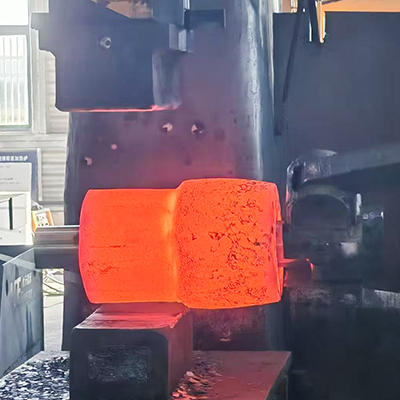 5MW–10MW Wind Turbine Planet Gear ForgingsCustom 1st–3rd stage planet gear forgings for 5–10 MW wind gearboxes, using 18CrNiMo7-6 or 42CrMo4 with 100% UT/PT/MPI inspection.View Product →
Typical Wind Drivetrain Forgings at a Glance
| Component | Typical material | Forming route | Key inspection |
|---|---|---|---|
| Planet carrier | 42CrMo4, 34CrNiMo6 | Open die forging, upset and drawn | Ultrasonic test, mechanical test, dimensions |
| Ring gear | 18CrNiMo7-6, 42CrMo4 | Ring rolling, then machining | Ultrasonic test, case depth, distortion after heat treatment |
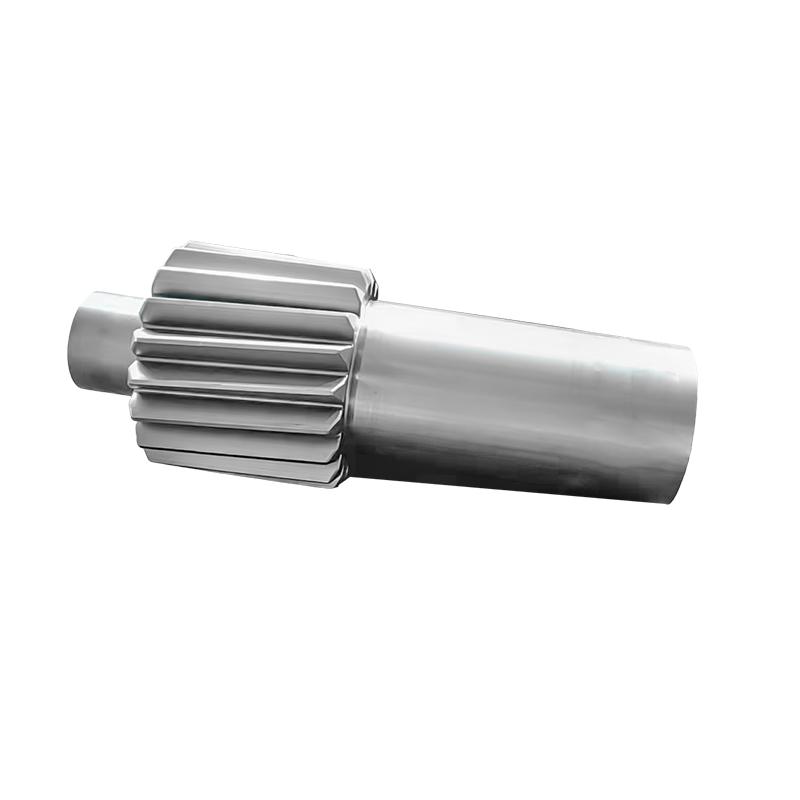
| Sun gear and planet gear | 18CrNiMo7-6, 20MnCr5 | Open die forging or upset, then hobbing | Case depth, profile, ultrasonic test |
| Main shaft | 34CrNiMo6, 42CrMo4 | Open die forging, heavy upset | Ultrasonic test, mechanical properties, concentricity |
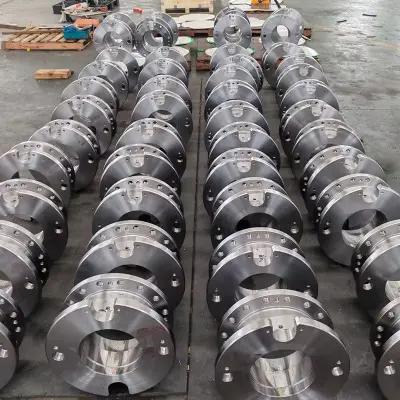
| Tower flange | S355NL, 42CrMo4 | Ring rolling | Ultrasonic test, flatness, hole position |
| Yaw and pitch bearing ring | 42CrMo4 and bearing steel variants | Ring rolling | Ultrasonic test, hardness, raceway tolerance |
Ring Rolling Capacity Is Often the Real Constraint
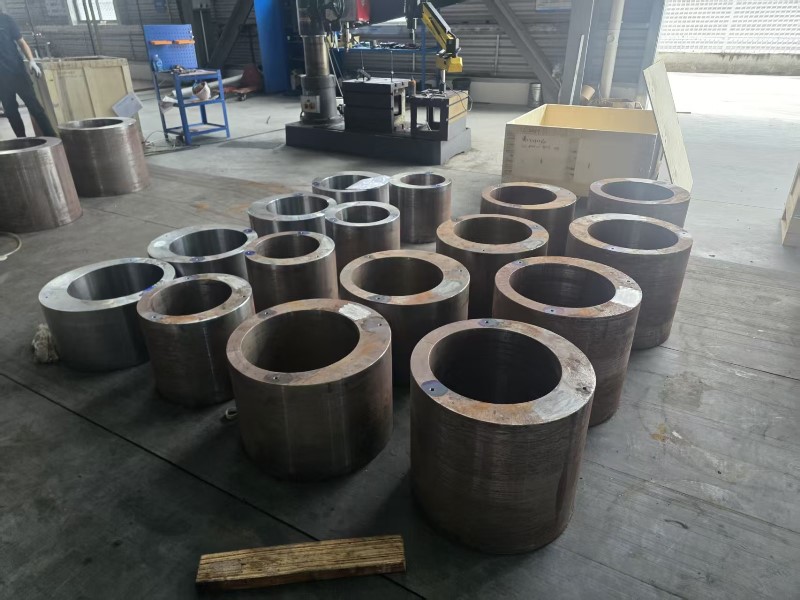
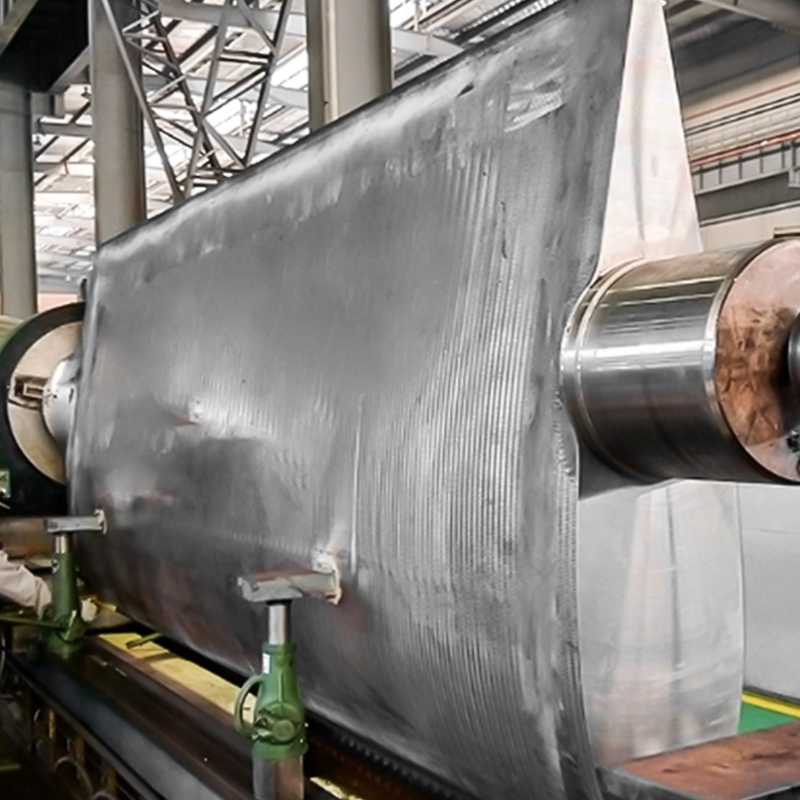
Ring gears, tower flanges and bearing rings are produced by radial axial ring rolling rather than open die forging, because rolling creates a circumferential grain flow that resists hoop stress far better than a part machined from plate or cut from a block.
Ring rolling capacity is defined by measurable limits:
- Maximum outside diameter, commonly 1 m to 1.5 m for mid sized mills, with a much smaller supplier pool beyond that.
- Maximum ring height and wall thickness, which determine whether a gearbox ring gear blank can be rolled in one sequence.
- Minimum bore diameter and wall thickness ratio, below which the ring loses stability during rolling.
A buyer comparing quotations should ask for these three numbers in writing. A quotation that omits them is often a quotation that will be subcontracted, adding a tier to the supply chain and another point where traceability can break down.
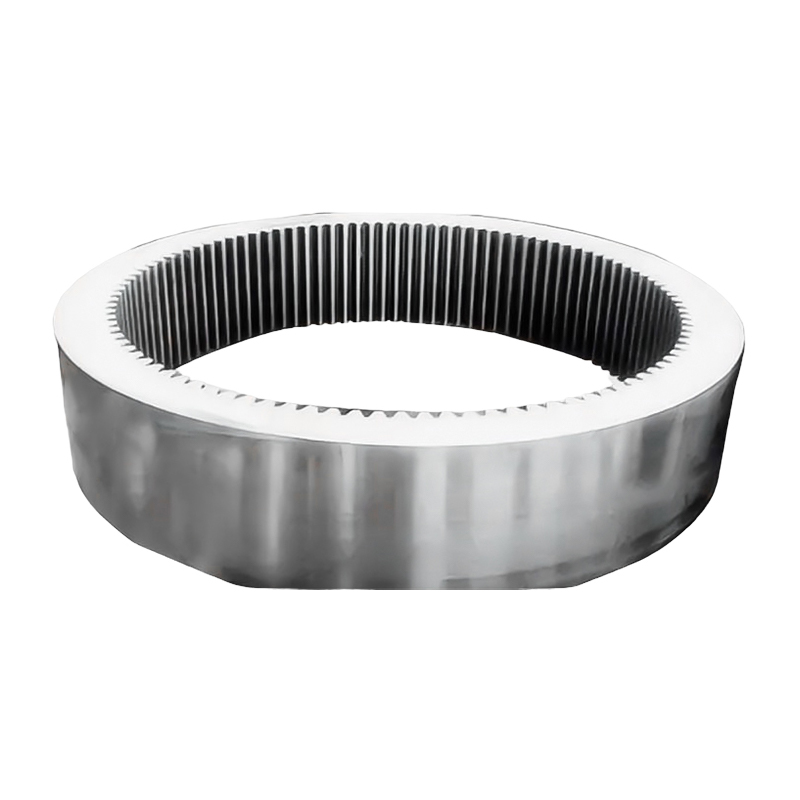 5MW–10MW Wind Turbine Ring Gear ForgingsRing gear forgings for 5–10 MW wind planetary systems, ring-rolled and carburized-quenched with precision-ground teeth for high-power loads.View Product →
What to Verify Before Placing an Order
- Forging equipment matched to part weight and envelope, with hammer or press tonnage stated.
- Heat treatment furnaces with documented load charts and quench capability for the section thickness involved.
- In house ultrasonic and surface inspection with qualified operators and reference blocks.
- Traceability from heat number to finished part, including any subcontracted operation.
- Machining capability, if finished parts are required instead of rough forgings.
- First article documentation from a comparable project, not a general brochure.
- Lead time that includes heat treatment and testing, not only forging hours.
- Agreed commercial terms on rework and non conformance, settled before the first heat is melted.
Where Cost and Risk Concentrate
Heat treatment is the most common source of scrap on large gearbox forgings. Quench cracking, insufficient case depth, excessive distortion and hardness variation around a large ring all appear after most of the material and machining cost has been committed. Distortion is especially expensive on ring gears, because the part must be re machined after heat treatment, and the allowance has to be planned in advance rather than corrected afterwards. Reviewing metal heat treatment fundamentals with a supplier is a quick way to test whether the process is understood or merely claimed.
Testing is the second concentration point. Ultrasonic inspection of a two tonne planet carrier takes time, needs a qualified operator, and produces a record that a customer engineering team may audit years later. Suppliers who treat inspection as a formality tend to appear as delivery problems rather than quality problems, which makes them harder to detect during quotation.
How ACE Group Supports Wind Gearbox Programs
ACE Group runs an integrated heavy manufacturing chain covering forging, heat treatment, precision machining, welded structures and heavy duty painting, with a product range that already includes power generation forgings for wind, hydro and nuclear applications. The core production base, Jiangsu ACE Energy Technology, began production in November 2025 on a 55 acre site with more than 50,018 square meters of built area.
Equipment relevant to wind gearbox work includes 3 tonne, 5 tonne and 15 tonne electro hydraulic hammers, 1 m and 1.5 m vertical ring rolling machines, gas fired heating furnaces, heat treatment resistance furnaces, quench tanks, induction hardening equipment and machining centres. For wind applications the range covers 3 MW to 10 MW gearbox components, including planet carriers, first, second and third stage planet gears, sun gears and first and second stage ring gears, alongside non standard custom forgings and finished machined parts.
The wind turbine forging market is not short of capacity in aggregate. It is short of capacity for large, heat treated, tested parts delivered to a predictable schedule. Buyers who confirm ring rolling limits, heat treatment capability and inspection scope before awarding an order avoid most of the delay risk, and they usually pay less for it as well, because rework and expedited freight never appear on the original quotation.
Message Us Right Now!
-
Mobile Terminal
-
Quick Links
Products About Us Equipment & Capacity Quality News Contact Us -
Product Category
Power‑Generation Forgings OEM Machined Forgings CUSTOMIZED MADE FORGING PARTS Ship and Port Machinery Forgings Mining and Metallurgy Forgings Food and Feed Machinery Forgings Welding Fabrication Petrochemical Industry Forgings -
Contact Us
Mob.: +86-173 7218 0878 Tel.: +86-515-8389 0396 E-mail: ivy.zhai@aceprocess.cn Add.: No.21 Jinfeng Road, Economic Development Park, Dafeng District, Yancheng City, Jiangsu, China
Copyright © 2025 Yancheng ACE Machinery Co., Ltd. All Rights Reserved.
China open die forgings manufacturer
custom precision forgings supplier
